-
How Thumbnail Sketches Reveal What Cartoonists Actually Think Before They Polish
Twenty thumbnail sketches of the same politician sit on my desk. Every one of them is wrong. Not wrong the way a finished drawing is wrong—a misplaced shadow, a likeness that drifts between sessions. Wrong the way a sentence is wrong when the structure underneath it hasn’t been thought through. The line is fine. The idea hasn’t landed. [SKETCH: A grid of twenty small pencil thumbnails, each roughly two inches square, showing the same figure in different compositional arrangements—some tiny in a vast empty frame, some looming with jowls filling the panel, one with his back turned, one reduced to a silhouette against a window. Most are crossed out with…
-
The Ethics of Drawing Historical Figures in Satire
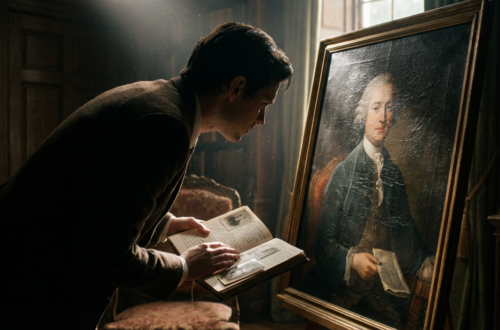
Historical figures are the easiest targets in a cartoonist’s arsenal—and the hardest to draw well. They show up pre-costumed, pre-scripted, pre-judged. Give Napoleon a hand tucked in his coat, Lincoln a stovepipe hat, Cleopatra a snake, and the audience does half the work. But the moment ink hits paper, you’re not just drawing a person. You’re drawing a memory, a myth, a classroom lesson, a national wound, a family heirloom. The ethics of satirizing the dead isn’t about being polite to ghosts. It’s about being honest with the living. This is where visual satire does its strangest work. A cartoon of a living politician is a provocation. A cartoon of…
-
Why Drawing Is Thinking: The Case for Visual Argument
Visual argument is not a picture that happens to have an opinion. It is a claim made with line, weight, and negative space—a form of reasoning that works before words arrive. In the world of editorial cartooning, syndicated strips, webcomics, and the occasional well-aimed meme, the drawing is the argument. It names a target, sets a frame, and asks the reader to complete the joke. That completion is the thinking. This article is for anyone who suspects that a well-drawn line can do more than decorate a page—it can cross-examine a politician, puncture a press release, and leave a bruise that a thousand-word op-ed would envy. Cartooning as civic practice…
-
How Political Cartooning Has Changed Since the Internet
Political cartooning is the art of drawing an argument. It is a visual shorthand for civic anger, absurdity, and hope—a line that says what a thousand editorials cannot. Adjacent to it sit editorial illustration, satirical comics, caricature, and the newer, messier world of memes. For readers of this blog, the question is not whether cartoons still matter. The question is how the internet has bent the old rules, broken a few, and handed the pen to everyone with a phone. I have been drawing for newspapers, then websites, then newsletters, and now whatever platform has not collapsed this month. The tools changed. The deadlines changed. The audience changed. But the…
-
The Cartoonist’s New Deadline: How the Internet Redrew Political Satire
Political cartooning was never a gentle art. It was a daily duel between ink and authority, a way of drawing the unsayable. But for most of its history, the duel had rules: a newspaper page, an editor’s nod, a printing press, a morning doorstep. The internet didn’t just move the duel online. It handed everyone a pen, removed the seconds, and set the duel in a town square where the crowd can throw fruit from any direction. The result is not simply faster cartoons or digital ink. It is a different civic practice—one where the drawn line argues in real time, often without a referee, and sometimes without a memory.…
-
The Ink Has Dried: How Political Cartooning Changed When the Internet Handed Everyone a Pen
Political cartooning used to be a civic ritual with a fixed stage: the morning paper, the editorial page, a single panel that could make a senator choke on his coffee. The cartoonist was a kind of licensed jester—paid to be rude, but only within the frame. The internet didn’t just move that frame. It smashed it, multiplied it, and handed a pen to everyone in the room. The result isn’t the death of political cartooning. It’s something stranger: a form that has lost its gatekeepers and gained a mob. This matters to anyone who reads visual satire as a civic practice. The drawn line has always argued, exposed, and provoked.…