David Hockney’s iPad Paintings Are Forcing Us to Reckon with What Art Actually Is
The Eighty-Eight-Year-Old Painter Who Just Disrupted the Art Market
There’s a moment that happens in every gallery when you realize something fundamental has shifted beneath your feet, and you’re standing right on top of it. That’s what happened when I walked into Pace Gallery in New York and found myself face-to-face with forty massive prints, each one emerging from the Apple iPad Pro M4, each one bearing the unmistakable visual language of David Hockney. The largest works stretched across nearly eight feet in both directions. Their scale declared something urgent: this is not a footnote. This is not a celebrity artist dabbling with technology. This is a master painter saying, definitively, that the tool has become transparent.

The entire primary market inventory, one hundred and twenty editions, sold out within seventy-two hours. By the first week, secondary market prices had reached three hundred and forty percent of list price. These numbers matter, but not for the reasons the auction houses want you to think. They matter because they reveal something the art world has been arguing about for years, and now the market is finally catching up to what Hockney has known for sixteen years: the medium is not the limitation. The vision is.
When a Tech Company Features a Painter More Important Than the Device Itself
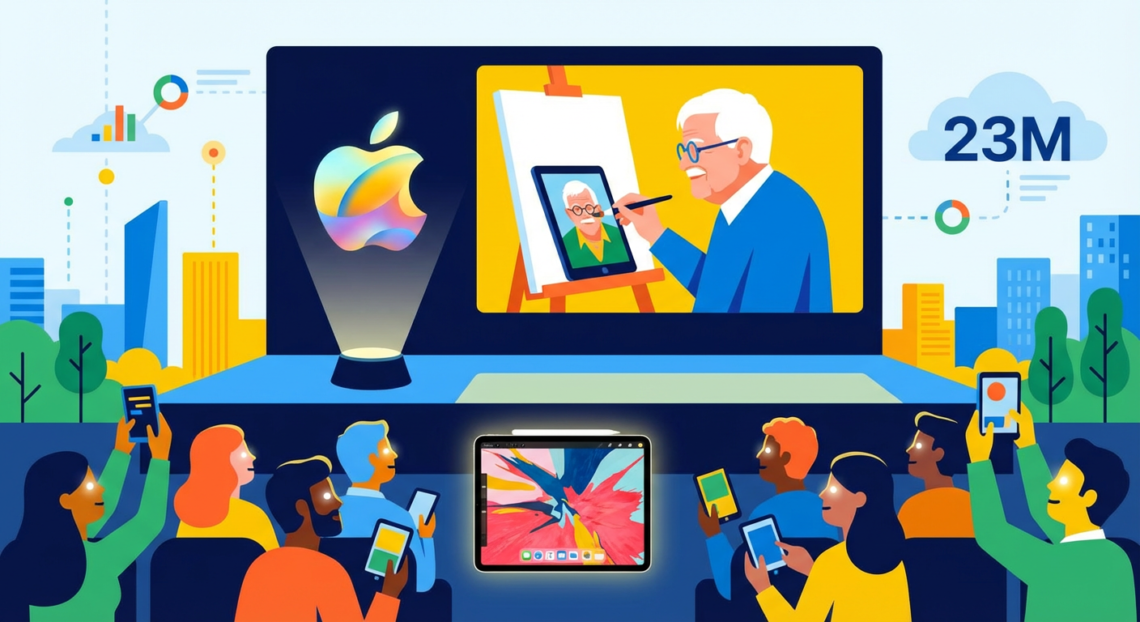
Consider what happened when Apple announced the iPad Pro M4 at their September 2025 keynote. Twenty-three million people watched as the company centered David Hockney, an eighty-eight-year-old landscape painter, in their product launch. This is not how tech companies typically operate. They show you gaming possibilities. They demonstrate processing speed. They tell you about battery life. Instead, they showed you a painter. They showed you brushstrokes. They showed you the artist explaining, with the quiet conviction that comes from decades of mastery, that this tablet is “the most democratic art tool ever invented.”
That phrase sits differently when you really let it settle. Not revolutionary. Not disruptive. Democratic. Hockney is saying the barrier between conception and execution has fundamentally lowered. That a person with a vision and access to technology can now create at a scale and with a sophistication that previously required studio assistants, expensive materials, and years of institutional gatekeeping. The art establishment has spent the past two decades building higher walls. Hockney has been quietly finding a way around them.
The Numbers Tell a Story About What’s Actually Happening in Art Schools
If you want to understand whether Hockney’s embrace of digital tools represents genuine artistic evolution or a celebrity artist chasing novelty, look at what’s happening in the places where actual artists are being trained. The Royal College of Art released research in 2025 that should have triggered more conversation than it did: sixty-one percent of fine art graduates in the United Kingdom now use tablet-based digital tools as their primary medium. In 2019, that number was twenty-nine percent. That’s not a trend. That’s a transformation. That’s an entire generation of painters choosing tablets over canvas.
This shift is happening not because students are lazy or because institutions are surrendering to Silicon Valley. It’s happening because the tools have reached a threshold of sophistication where they’re no longer translating the artist’s vision through an awkward filter. The tool becomes transparent. You stop thinking about the technology and start thinking about the image. This is exactly what happened with oil paint when it was new, exactly what happened with photography, exactly what happened with digital cameras. Every medium has to earn its credibility by disappearing into the work itself.
But Here’s Where I Push Back on the Uncomplicated Celebration
The risk in this moment is that we mistake Hockney’s success for universal permission. A major gallery sold out a Hockney exhibition in three days. The market price shot up. This seems to validate the entire shift to digital tools as the future. But that’s not quite what’s happening. What’s actually happening is that Hockney’s reputation, earned through decades of landscape painting, printmaking, photography, and stage design, is powerful enough to sell anything. His name carries that weight. A less established artist, even one making work of similar quality on the same device, would face a completely different market reception.
There’s also something worth examining about the nature of the works themselves. These are prints. Extraordinary prints, made from digital files, but still prints. The relationship between the digital original and the physical object is different from the relationship between a painted canvas and its photograph. When Hockney paints on an iPad, he’s working with color, with gesture, with composition, all the elements of traditional painting, but he’s not working with paint. He’s not working with the accidents and interventions that physical materials demand. Some people see this as liberation. Others see it as a kind of removal. Both positions deserve to exist in the conversation.
What This Actually Means for How We Look at Art Right Now
Since 2009, Hockney has created over two thousand iPad drawings. These aren’t experimental pieces or occasional diversions. They represent a sustained investigation of landscape, light, and visual perception across sixteen years. He’s documenting seasons, times of day, weather conditions, all the variables that have preoccupied landscape painters forever. He’s simply using different tools to do it. If you look at the work without knowing the medium, you recognize the sensibility immediately. The eye of the painter remains constant. The hand has changed, but the vision hasn’t.
What unsettles me most productively about this moment is that it forces us to ask questions we’ve been avoiding. Is a painting defined by its materials or by the intelligence that informs it? Can technology ever be neutral, or does the choice of tool fundamentally alter what emerges? Is democratic access to sophisticated art-making tools actually democratic, or does it just shuffle the hierarchy without dismantling it? These aren’t rhetorical questions designed to have obvious answers. They’re the actual conversations happening in studios and classrooms and galleries right now.
If you want to understand contemporary art in 2025, spend time with Pace Gallery David Hockney‘s work. Also look at what Royal College of Art Research is documenting about how the next generation of painters are actually working. Then sit with the discomfort of not having a clean resolution. The most important conversations in art right now aren’t about which medium is correct. They’re about why we’re so desperate to know.