The Silent Conversations: How Portrait Paintings Whisper Their Secrets
Standing Before the Canvas
I’m standing three feet from Kehinde Wiley’s “Napoleon Leading the Army over the Alps” at the Brooklyn Museum, watching visitors pause mid-stride. Their faces shift from casual gallery browsing to something closer to recognition, then puzzlement. The young Black man in Nike sneakers and camouflage bandana sits in Napoleon’s exact pose from Jacques-Louis David’s 1801 masterpiece, but everything else screams 21st century. A woman beside me whispers to her companion, “Is that supposed to be Napoleon?” She’s asking the right question, just not in the way she thinks.
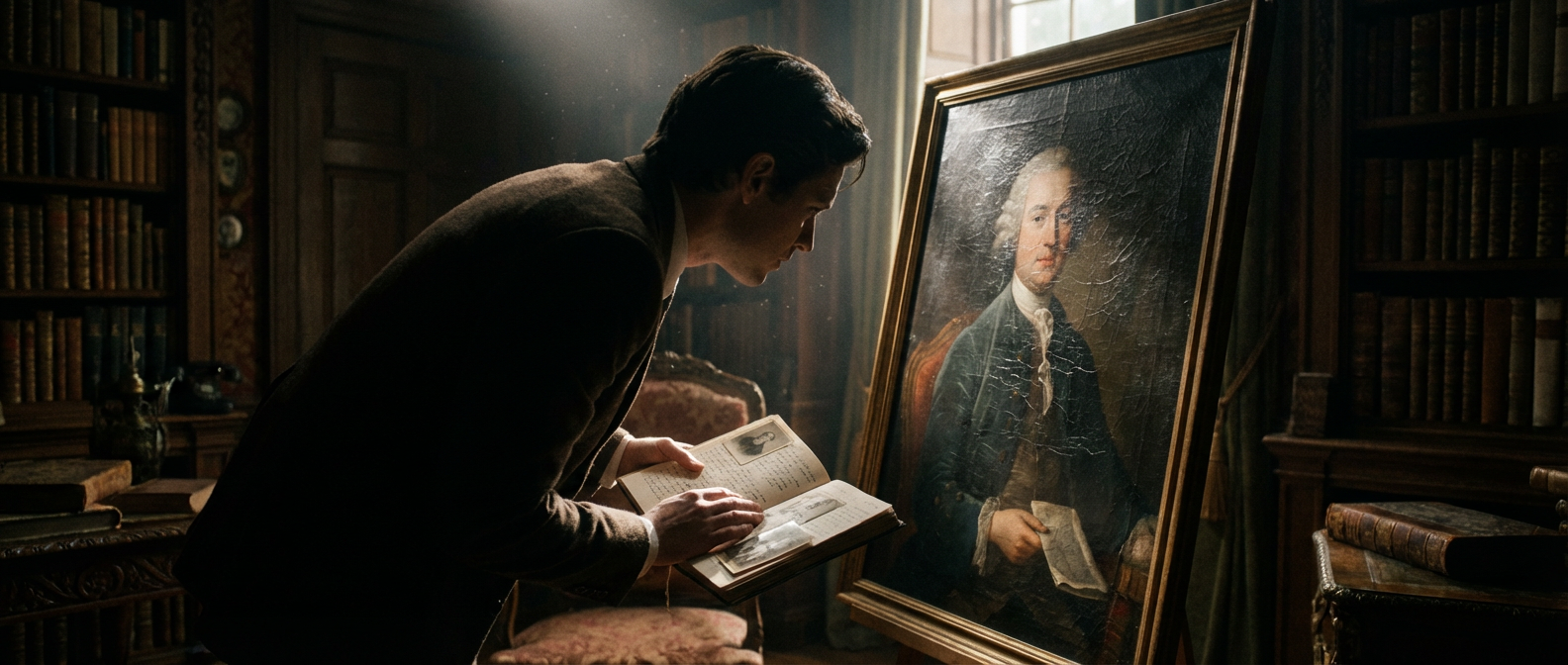
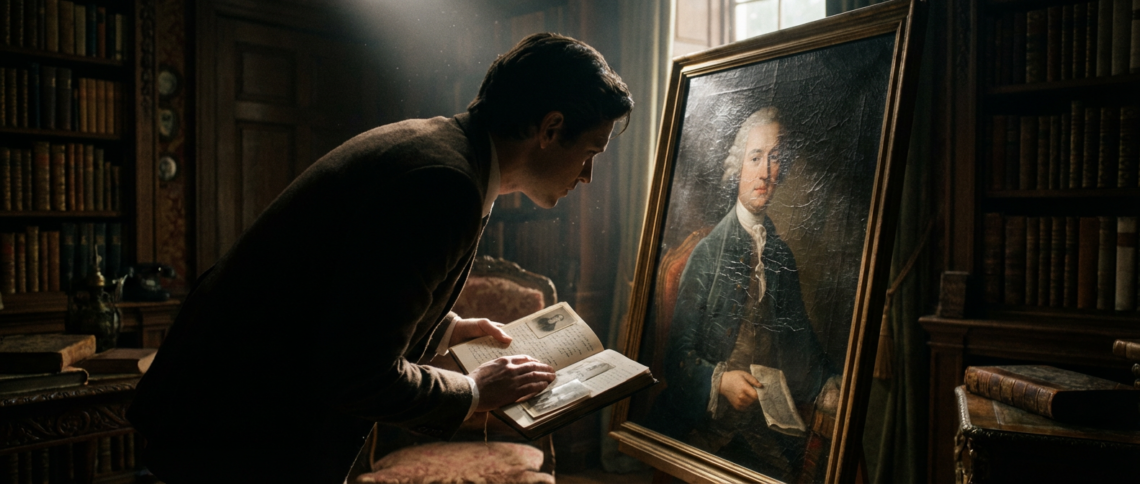
This is where portrait reading begins. Not with art history textbooks or wall placards, but with that moment of visual friction when your brain tries to make sense of what you’re seeing. Every portrait painting holds multiple conversations at once: the one between artist and subject, the one between artist and viewer, and the one between the cultural moment when it was painted and the cultural moment when you’re standing before it.
Wiley’s work makes these conversations impossible to ignore. His subjects are young Black and brown men from urban neighborhoods, painted in the grand style of European court portraiture. They’re surrounded by ornate floral backgrounds that pull from French rococo wallpaper and African textile patterns. The collision is deliberate and electric. You’re watching an artist systematically insert bodies that were historically excluded from positions of power into the visual language that was designed to celebrate that very power.

Reading the Language of Power
Portrait painting has always been about power, whether the subject had it, wanted it, or was deliberately kept from it. When I look at Hans Holbein the Younger’s portraits of Henry VIII, I’m not just seeing a king—I’m reading a carefully built manual for absolute authority. Every detail serves the story: the wide-legged stance that claims space, the direct gaze that refuses to acknowledge any superior, the rich fabrics that translate into economic dominance, even how light falls to emphasize the king’s physical bulk and presence.
But power works differently across centuries and cultures. In Frida Kahlo’s self-portraits, power becomes something more complex and internal. When she paints herself with a unibrow and facial hair, she’s rejecting European beauty standards and claiming the right to define feminine strength on her own terms. Her direct gaze works differently than Henry’s. Where his demands submission, hers demands recognition of her full humanity in a world determined to diminish it.
I’ve spent hours with John Singer Sargent’s portrait of Madame X at the Metropolitan Museum, watching people react to her pale skin, dramatic profile, and that infamous fallen dress strap. What they’re witnessing is a scandal frozen in time. Virginie Amélie Avegno Gautreau was a Parisian socialite known for her beauty and rumored affairs. Sargent’s original version showed her dress strap completely fallen, creating such an uproar at the 1884 Paris Salon that he later painted it back onto her shoulder. Even in its “modest” version, the portrait radiates sexual confidence and social transgression. She’s performing femininity, but on her own terms, and the result nearly destroyed both their careers.
The Stories Bodies Tell
Portraiture is basically about the body as text, and learning to read that text requires understanding both artistic conventions and cultural contexts. When I examine Chuck Close’s photorealistic self-portraits, I’m reading a completely different relationship to the body than what I see in classical portraiture. Close, who lives with face blindness and was later paralyzed from the neck down, creates portraits that work almost like topographical maps. Every pore, wrinkle, and facial hair becomes significant. His technique builds images from thousands of tiny colored squares, mirroring how he actually processes faces by breaking them into manageable geometric parts.
The scale matters too. Close’s portraits are enormous, forcing viewers to confront the human face at a level of detail that’s almost uncomfortable. You can’t take in the whole image at once. Instead, you’re forced to move around it, reading it section by section like a vast landscape. This isn’t just artistic choice. It’s autobiography rendered in paint and canvas.
Alice Neel’s portraits tell different stories about bodies and identity. Her 1970 painting of Andy Warhol, created just two years after he was shot, shows him shirtless and scarred, wearing a corset-like surgical support. Neel strips away Warhol’s carefully constructed public persona to reveal physical vulnerability. The painting reads like a meditation on mortality and fame, showing how violence leaves marks that no amount of celebrity can erase.
Cultural Codes and Hidden Narratives
Every portrait exists in dialogue with the visual culture of its time, and sometimes the most interesting stories hide in seemingly minor details. When I look at Kerry James Marshall’s “Past Times,” I’m reading a masterpiece of cultural code-switching. The scene depicts an idyllic picnic with Black families enjoying leisure time, painted in Marshall’s signature style where figures appear almost impossibly dark against bright, cheerful backgrounds. The composition references both American folk art and European pastoral painting, but the presence of Black families in this setting carries profound historical weight.
Marshall is painting Black joy and leisure into spaces where it was historically forbidden or invisible. The children flying kites, the couples embracing, the general atmosphere of carefree recreation become radical acts when you consider how rarely Black Americans have been depicted simply enjoying life rather than struggling against oppression or serving others.
Similarly, when I study portraits from the Dutch Golden Age, I’m reading complex negotiations between Protestant values, merchant wealth, and artistic ambition. The black clothing in many of these portraits isn’t just fashion, it’s theology. Protestant reformed churches discouraged flashiness, so wealthy merchants had to find subtle ways to display their success. Master artists like Rembrandt developed techniques for painting black fabric with incredible richness and depth, turning religious restraint into opportunities for masterful displays of skill.
The Conversation Continues
Portrait reading becomes addictive once you start recognizing the patterns and disruptions. Every time I encounter a new portrait, I find myself automatically scanning for the power dynamics, the cultural codes, the ways the artist has chosen to represent human dignity or vulnerability or aspiration. The conversation between viewer and painting is never one-sided. We bring our own historical moment, our own biases and experiences, to every encounter.
The most powerful portraits acknowledge this dynamic conversation explicitly. They seem to look back at us with the same intensity we bring to looking at them. They remind us that portraiture isn’t just about preserving someone’s appearance, it’s about preserving the complex web of relationships, power structures, and cultural values that shaped how they moved through the world.
Next time you find yourself before a portrait that stops you in your tracks, trust that moment of recognition. The painting is trying to tell you something that goes far beyond the identity of its subject. Listen to what it’s whispering about power, identity, beauty, resistance, and the countless ways humans have tried to assert their presence in an indifferent universe. The conversation is waiting for you to join it.