How Political Cartooning Has Changed Since the Internet
Political cartooning is the art of drawing an argument. It is a visual shorthand for civic anger, absurdity, and hope—a line that says what a thousand editorials cannot. Adjacent to it sit editorial illustration, satirical comics, caricature, and the newer, messier world of memes. For readers of this blog, the question is not whether cartoons still matter. The question is how the internet has bent the old rules, broken a few, and handed the pen to everyone with a phone.
I have been drawing for newspapers, then websites, then newsletters, and now whatever platform has not collapsed this month. The tools changed. The deadlines changed. The audience changed. But the core job—making a reader laugh, then pause, then maybe get a little uncomfortable—has stayed oddly intact.
The Old Gatekeepers and the New Firehose
Before the internet, a political cartoonist needed three things: talent, a syndicate, and an editor with a strong stomach. The cartoon appeared once a day, in one paper, at a fixed size. If the editor killed it, the drawing vanished. The cartoonist’s power was real but narrow. A single panel could define a politician’s week, but only if the gatekeepers let it through.
Now the gate is gone. A cartoonist can post a drawing at 7 a.m. and have it seen in Jakarta by 7:04. The syndicate is optional. The editor is optional. The audience is not. That sounds liberating, and it is. But it also means the cartoonist now competes with every meme account, every hot take, and every algorithm that rewards outrage over craft.
The tradeoff is stark. The old system gave cartoonists a platform but limited their reach. The new system gives them reach but no guarantee of being seen. A drawing can go viral for the wrong reason—a misread caption, a cropped panel, a stolen image with the signature removed. The internet did not kill political cartooning. It just made the cartoonist’s job harder in a new way.
From Daily Deadline to Perpetual Now
Newspaper cartoonists worked on a daily cycle. You read the morning news, sketched by noon, inked by four, and the paper hit the porch by six. The cartoon was a snapshot of one day’s outrage. By the next morning, it was wrapping fish.
The internet has no porch. The news cycle is a continuous scroll. A cartoon about a 9 a.m. gaffe feels stale by 2 p.m. The cartoonist now works in a state of perpetual now, where the half-life of a joke is measured in hours, not days. Some cartoonists have adapted by drawing faster, looser, and more often. Others have slowed down on purpose, choosing to comment on the pattern rather than the incident.
I have tried both. The fast approach feels like shouting into a wind tunnel. The slow approach feels like writing a letter to a friend who may have moved. Neither is wrong. But the internet rewards the fast one, and that shapes what gets drawn.
The Rise of the Amateur and the Death of the Signature
Once, a political cartoon was a signed object. The style was the signature. A reader could spot a Herblock or an Oliphant from across the room. The line, the crosshatching, the way a nose was drawn—these were as personal as a fingerprint.
Now the signature is often cropped out, or never added. A cartoon becomes a template. Someone screenshots it, adds a new caption, and reposts it. The original artist may never know. The drawing becomes a meme, and the meme becomes the point. This is not always bad. A good idea can travel further as a meme than as a signed cartoon. But it does mean the cartoonist’s identity is less tied to the work. The internet has democratized the form and, in the process, made the individual cartoonist a little more anonymous.
That anonymity has a cost. When a cartoon is shared without context, the reader may not know if it is satire, sincerity, or a deliberate provocation. The old newspaper page provided context: the editorial page, the masthead, the neighboring columns. The internet provides none of that. A cartoon floats alone, and the reader must decide what it means. Sometimes that decision is generous. Sometimes it is not.
New Tools, New Lines
The tools have changed too. I still draw with a nib and ink, but I scan the drawing and clean it up on a tablet. Some cartoonists draw entirely on screens. Others use vector software, or collage, or a mix of photo and line. The internet did not invent these tools, but it made them cheap and universal. A teenager with a free drawing app can produce a sharper line than I could at their age with a crow quill.
That is a good thing. The barrier to entry has collapsed. But the tools also change the look of the work. Digital lines are cleaner, more uniform, less alive. A hand-drawn line wobbles. It hesitates. It has a pulse. A digital line can be perfect, and perfection is not always funny. The best digital cartoonists learn to reintroduce the wobble, to make the tool feel like a hand. That is a skill in itself.
I have seen young cartoonists do things with a tablet that I could never do with a brush. I have also seen them lose the texture that makes a drawing feel human. The internet did not settle this argument. It just made the argument louder.
The Audience Talks Back
In the old days, a cartoonist got letters. Angry letters, mostly. They arrived days later, typed or scrawled, and they went into a drawer. Now the audience talks back in real time. The comments section is the new letters page, and it is not polite.
This changes the work. A cartoonist who reads the comments may start to self-censor, or to provoke on purpose, or to chase the reaction. A cartoonist who ignores the comments may miss a real correction or a better idea. The internet has made the audience part of the process, for better and worse. A cartoon is no longer a monologue. It is the opening line of an argument that may last all day.
I have learned to read the comments with one eye closed. Some of them are smarter than my cartoon. Some of them are not. The trick is knowing which is which before the algorithm decides for you.
Memes as the New Editorial Cartoon
It is tempting to say that memes have replaced editorial cartoons. That is not quite right. A meme is a unit of cultural shorthand. An editorial cartoon is an argument. A meme can be an argument, but it is often just a mood. The best memes work like cartoons: a setup, a pause, a cut. The worst memes are just noise.
What the internet did was blur the line between the two. A political cartoon can become a meme. A meme can become a political cartoon. The difference is intent. A cartoonist intends to make a point. A meme-maker may just intend to make a joke. The point may arrive anyway, but it is not the same craft.
I have seen my own cartoons turned into memes. Sometimes the new caption is better than mine. Sometimes it is worse. Either way, the drawing has left my hands. That is the deal now. You draw it, you post it, and the internet does what it does.
The Economics of the Digital Cartoonist
Let me be blunt: the money got weird. A newspaper cartoonist used to earn a salary or a syndication fee. The internet killed a lot of that. Now a cartoonist may earn from Patreon, or Substack, or print sales, or the occasional commissioned illustration. Some cartoonists do fine. Most do not.
The internet made distribution free and attention expensive. A cartoonist can reach a million people and still struggle to pay for ink. The old model was flawed—too few voices, too many gatekeepers. The new model is also flawed—too many voices, too few paying readers. The cartoonist now has to be an artist, a marketer, a community manager, and a small business owner. That is a lot of hats for one head.
I have tried most of the platforms. Some of them pay. Some of them promise to pay. Some of them just want your drawings for free. The trick is to keep drawing anyway, because the alternative is to stop, and stopping is not an option.
What Has Not Changed
For all the upheaval, some things hold. A good political cartoon still needs an idea. The line still has to carry the idea. The joke still has to land. The reader still has to feel the small shock of recognition—the moment when the drawing says what they were thinking but could not say.
The internet did not change that. It just changed the speed, the scale, and the noise around it. A cartoonist today is still trying to do the same thing Herblock did in 1950: draw a line that makes someone think. The difference is that now the line can be seen by everyone, and argued about by everyone, and stolen by everyone, all before lunch.
That is not a tragedy. It is just a new set of problems. And problems, as any cartoonist knows, are the raw material of the job.
Three Drawings That Show the Shift
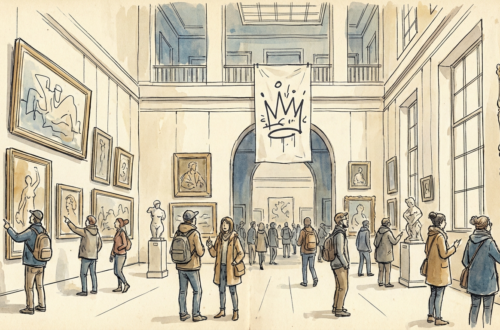
Let me show you what I mean. The images below are not political cartoons in the traditional sense. They are the kind of images that now circulate in the same space—faces, crowds, gestures, the raw material of public argument. A cartoonist today works with this visual noise every day.

The first image is a reminder that the craft still starts with a hand and a surface. The internet did not erase that. It just added a screen between the hand and the audience.

The second image is the new audience: a group of people looking at a screen, not a newspaper. They may see your cartoon for three seconds. They may share it. They may not. The cartoonist has to earn those three seconds.

The third image is the slow work. The pen, the notebook, the pause before the line. The internet has not made this part faster. It has just made it more public.
What the Internet Took, and What It Gave
The internet took the gatekeepers, the daily deadline, the signed object, and the steady paycheck. It gave the cartoonist a global audience, instant feedback, new tools, and a new kind of freedom. The trade is not even. But it is the trade we have.
A cartoonist today has to be more than a cartoonist. She has to be a publisher, a moderator, a brand, and a person who can take a punch. The old cartoonists had thick skins. The new ones need armor.
But the job is still the job. Draw the line. Make the point. Leave room for the reader to think. The internet changed everything around that job. It did not change the job itself.
FAQ: Political Cartooning in the Internet Age
Are political cartoons still relevant in the age of memes?
Yes, but their role has shifted. A political cartoon is still a deliberate, crafted argument. A meme is often a spontaneous reaction. The two now overlap, and a good cartoon can become a meme. But the cartoonist’s intent—to make a specific point with a specific line—remains distinct. The internet has not replaced that intent. It has just made it harder to see amid the noise.
How do digital tools change the look of political cartoons?
Digital tools make the line cleaner, the color easier, and the workflow faster. But they can also flatten the texture that gives a drawing its personality. Many cartoonists now mix hand-drawn and digital work to keep the wobble in the line. The best digital cartoonists learn to make the tool feel like a hand, not a machine.
Can a political cartoonist make a living online?
It is possible, but it is not easy. Revenue now comes from a mix of subscriptions, print sales, commissions, and platform payouts. The audience is larger than ever, but attention is cheap and money is scarce. A cartoonist today has to be an artist and a small business owner. The ones who survive are the ones who keep drawing through the lean months.
What should a reader look for in a good political cartoon?
Look for the idea first. A good cartoon has a clear point, even if it is wrapped in a joke. Then look at the line—does it feel alive? Then look at the pause. The best cartoons leave a small silence between the setup and the punchline, a moment where the reader has to finish the thought. That pause is the cartoonist’s gift. The internet has not taken it away.
Where This Leaves Us
The internet did not end political cartooning. It just moved the goalposts, turned on the floodlights, and invited the whole world to referee. The cartoonist now works in a louder room, with more voices and fewer certainties. That is not a bad thing. It is just a different thing.
I still draw every day. I still post the drawing. I still read the comments with one eye closed. And I still believe that a single line, placed well, can do more than a thousand posts. The internet has not changed that. It has just made the line harder to find.
If you want to see where this goes next, watch the young cartoonists. They are drawing on phones, posting to platforms that did not exist five years ago, and making arguments that would have been unpublishable in the old papers. They are the next panel in a long strip. The strip is not over. It is just being redrawn.