Blog
-
The MoMA Basquiat Retrospective: When Institutional Validation Becomes a Mirror for Our Own Contradictions
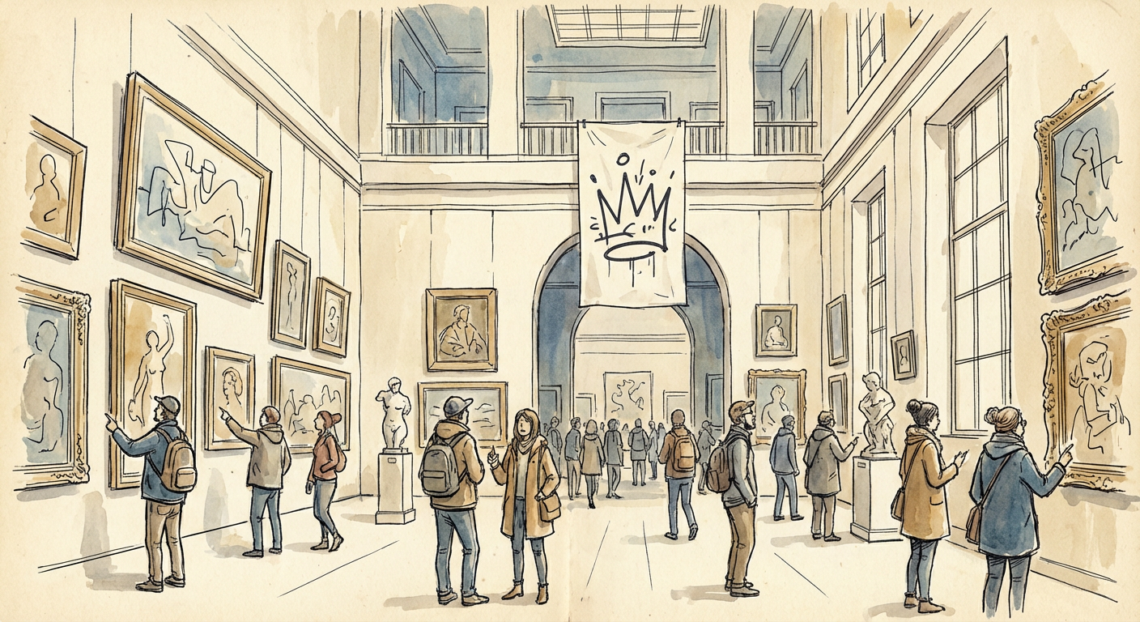
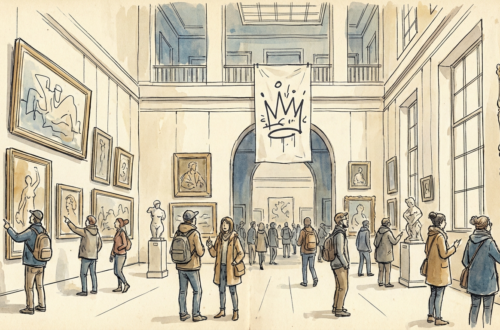
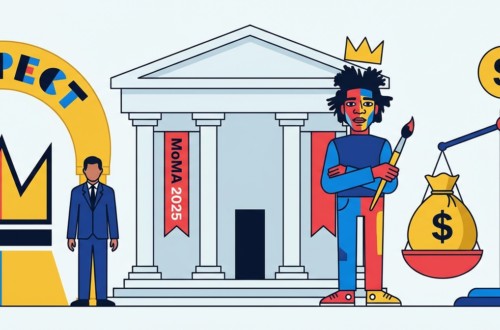
The Scale of Ambition, the Weight of Questions When MoMA announced its 2025 Basquiat retrospective, I felt that familiar electric tingle—the one that comes right before you walk into a gallery and everything suddenly makes sense. Over 200 works spanning from his early tag-filled notebooks through his final, fevered paintings. One of the largest solo exhibitions of his work ever mounted in North America. But here’s where my enthusiasm catches itself mid-breath: I also felt something else entirely. A small, uncomfortable knot of doubt. The MoMA Basquiat Retrospective: When Institutional Validation Becomes a Mirror for Our Own Contradictions This isn’t cynicism dressed up as criticism. It’s the genuine confusion of…
-
Venice 2026 and the Ongoing Revolution: How the ‘Stranieri Ovunque’ Legacy Is Permanently Changing the Biennale
The Moment That Changed Everything There’s a particular kind of electricity that runs through the art world when something genuinely shifts beneath the surface. That’s what happened in 2024 when Adriano Pedrosa, the first Latin American curator to ever helm the Venice Biennale, titled his exhibition “Stranieri Ovunque” — Foreigners Everywhere. The title felt like a quiet provocation, an invitation to interrogate who gets to belong in the spaces that matter most. Now, as we move toward the 61st Venice Biennale opening in April 2026, that provocation hasn’t faded. It’s grown more urgent, more impossible to ignore. What makes Pedrosa’s curatorial vision so significant isn’t just that he brought a…
-
David Hockney’s iPad Paintings Are Forcing Us to Reckon with What Art Actually Is
The Eighty-Eight-Year-Old Painter Who Just Disrupted the Art Market There’s a moment that happens in every gallery when you realize something fundamental has shifted beneath your feet, and you’re standing right on top of it. That’s what happened when I walked into Pace Gallery in New York and found myself face-to-face with forty massive prints, each one emerging from the Apple iPad Pro M4, each one bearing the unmistakable visual language of David Hockney. The largest works stretched across nearly eight feet in both directions. Their scale declared something urgent: this is not a footnote. This is not a celebrity artist dabbling with technology. This is a master painter saying,…
-
Color Field Painting Is Going Viral, and Maybe That’s Exactly What It Needed
The Unexpected Moment When Paint Met Algorithm There’s a particular kind of cognitive dissonance that happens when you see something you love suddenly everywhere. For those of us who’ve spent years contemplating the meditative expanses of Helen Frankenthaler’s stained canvases or the optical possibilities in Morris Louis’s veils of color, the past eighteen months have felt surreal. Color Field painting, a movement that emerged from mid-century abstract expressionism and often felt like the quiet intellectual cousin at the museum’s cocktail party, has become TikTok’s unlikely darling. The numbers tell a story that would have seemed impossible just two years ago: by the first quarter of 2026, the hashtag #ColorFieldPainting accumulated…
-
The Louvre’s Reckoning: Why Moving the Mona Lisa Matters More Than the Painting Itself
When Eight Million Visitors Becomes a Crowd Problem Let me paint you a picture that has nothing to do with Leonardo. Imagine standing in a corridor so densely packed that you cannot lift your arms to shoulder height. Imagine traveling thousands of miles, saving for months, finally arriving at the museum you have dreamed about since childhood, only to catch a glimpse of a painting through a scrim of phone screens and elbows. This is not hyperbole. This is the current reality at the Louvre, where 8.9 million people shuffled through its doors in 2024 alone, making it the most visited art museum on the planet for the twenty-ninth consecutive…
-
Kendrick Lamar’s Super Bowl LIX Halftime Show: The Art Statement the NFL Couldn’t Control
When 133 Million Viewers Witnessed a Deconstruction of American Mythology There’s a particular kind of artistic audacity that happens when a creator accepts an invitation into the machine and then uses that machine against itself. Kendrick Lamar’s halftime performance at Super Bowl LIX in New Orleans wasn’t just a concert sandwiched between commercials and network promos. It was a carefully orchestrated dismantling of the mythology that the NFL has spent decades constructing and protecting. With an estimated 133.5 million viewers tuned in, Lamar performed not just for the live stadium audience but for what might be the largest gallery opening in human history. Kendrick Lamar’s Super Bowl LIX Halftime Show:…