The MoMA Basquiat Retrospective: When Institutional Validation Becomes a Mirror for Our Own Contradictions
The Scale of Ambition, the Weight of Questions
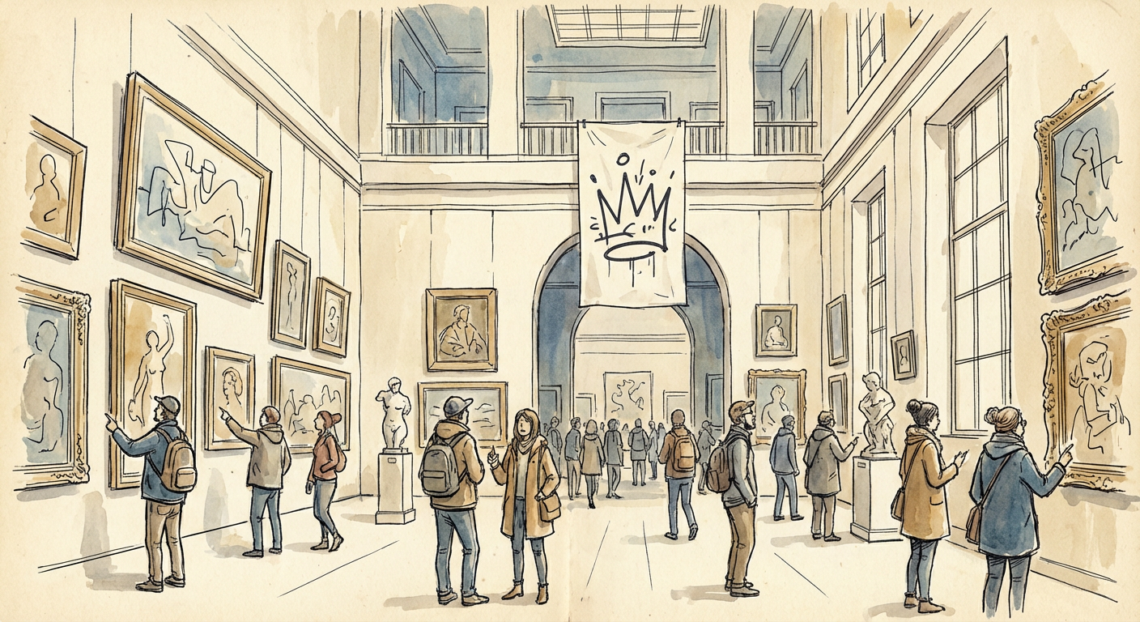
When MoMA announced its 2025 Basquiat retrospective, I felt that familiar electric tingle—the one that comes right before you walk into a gallery and everything suddenly makes sense. Over 200 works spanning from his early tag-filled notebooks through his final, fevered paintings. One of the largest solo exhibitions of his work ever mounted in North America. But here’s where my enthusiasm catches itself mid-breath: I also felt something else entirely. A small, uncomfortable knot of doubt.
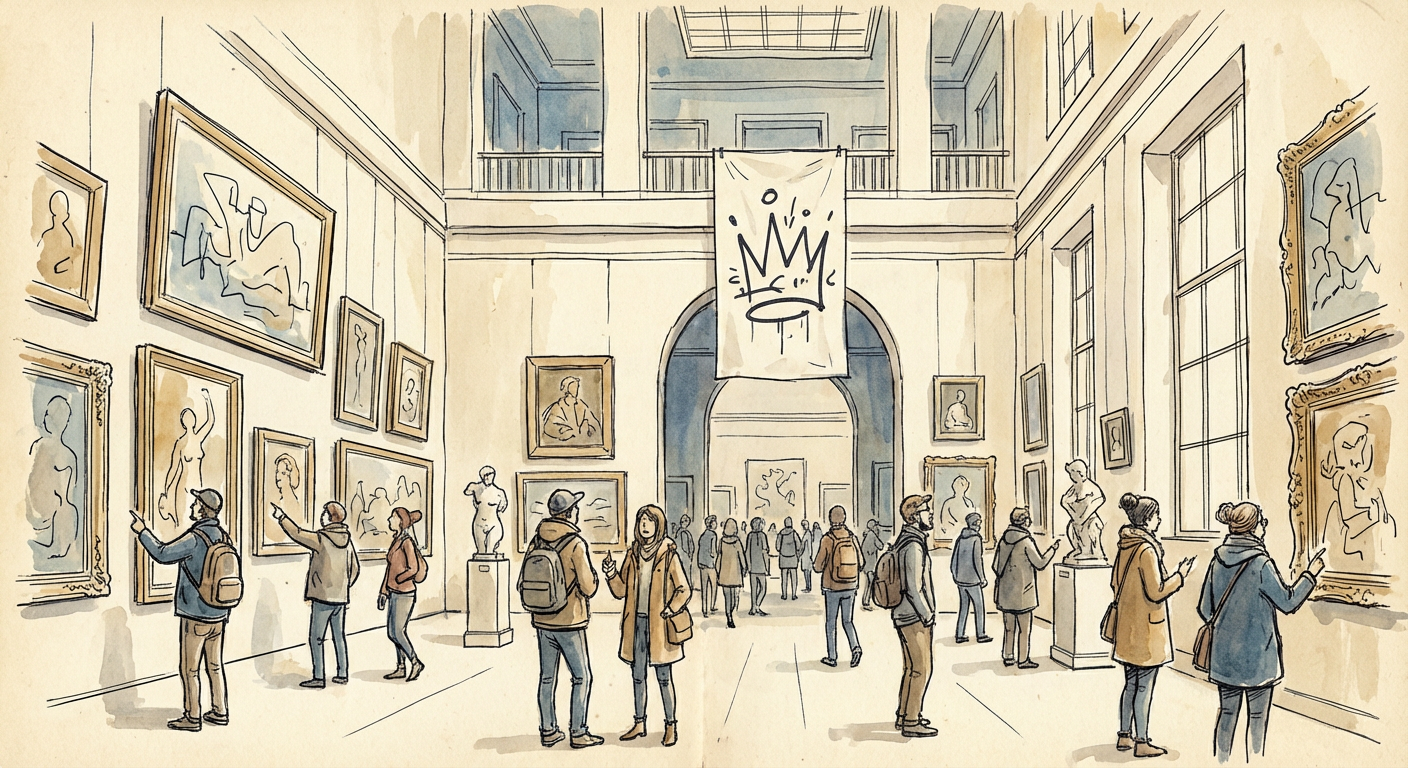
This isn’t cynicism dressed up as criticism. It’s the genuine confusion of someone who has spent considerable time studying Basquiat’s actual process, his materials, his intentions, and who now finds herself standing at a crossroads between two equally valid interpretations of what this exhibition represents. Is it the institutional recognition an artist of his caliber deserves? Or is it something far more complicated—a conversation about money and legacy and who gets to tell an artist’s story after they’re gone?
The Craft That Built the Mythology
Let me start with what matters most to me: the actual work. Basquiat’s technical practice was far more deliberate than the mythology of the frenetic genius allows. He worked in layers. Charcoal under acrylic under oil stick. He scraped back to canvas, burned through surfaces, wrote words that functioned simultaneously as linguistic content and as compositional elements. Watch him work in footage from the 1980s and you’re seeing someone who understood the fundamental relationship between gesture and meaning that painters have grappled with since the Renaissance.
What makes the retrospective format potentially valuable is that it lets us see this evolution in real time. Early works show him experimenting with repetition and symbol-building. Middle works demonstrate increasing sophistication in how he layered cultural references—from anatomy textbooks to street language to high art history. Late works reveal an artist working at maximum intensity, sometimes frantically, sometimes with surgical precision. The progression isn’t just stylistic evolution. It’s a thinking process made visible on canvas. That’s worth showing.
When you see 200 works together, you begin to notice the patterns that a single painting can’t reveal. The way certain symbols recur. How his color relationships deepened. The specific way he handled edges versus centers. These are the kinds of observations that emerge only through sustained looking, through the kind of curatorial work that asks viewers to slow down and notice craft.
The Elephant in Every Exhibition Space
But we cannot pretend the market context doesn’t exist. In 2017, one of Basquiat’s untitled paintings sold at Sotheby’s for $110.5 million, setting the record for an American artist at auction. That number has only intensified the speculation around his work. According to ArtTactic Art Market Reports, Basquiat’s secondary market sales increased by 22 percent year-over-year heading into 2025. That’s not organic interest. That’s a market reacting to scarcity, institutional attention, and the reliable formula that a major retrospective at MoMA tends to amplify all three.
MoMA itself reported record attendance figures in 2024, with over 3.2 million visitors. Blockbuster retrospectives accounted for roughly 40 percent of those annual foot traffic surges. So we’re working with institutional incentives that are real and substantial. Museums need attendance. Attendance funds operations. Operations fund scholarship and education and conservation. I’m not judging this ecosystem. I’m acknowledging it exists.
The uncomfortable question becomes: how much of this exhibition is about helping us understand Basquiat better, and how much is the exhibition functioning as a market signal to collectors? These aren’t mutually exclusive. But they’re also in tension with each other in ways worth articulating.
The Authentication Problem and the Estate Question
There’s a specific historical wound here that adds another layer of complexity. Basquiat’s authentication process has been genuinely troubled. The Jean-Michel Basquiat Authentication Committee, which operated for decades, was dissolved in 2012. What followed were disputes significant enough that the Supreme Court of New York had to rule on authentication practices in 2022. When your estate’s credibility around what is and isn’t authentic work has been legally challenged, a massive retrospective becomes more fraught.
Not because I believe MoMA has included inauthentic works. But because the authentication debates themselves reveal something important about how Basquiat’s legacy is being managed and mediated. His work has become so valuable that the stakes of authentication literally matter in millions of dollars. That changes how we can talk about it, colors how institutional presentations function. An exhibition becomes not just an exhibition but a kind of institutional guarantee about what counts as legitimate work.
Looking Beyond the Question Itself
Here’s what I keep returning to: the real value of this retrospective isn’t determined by whether it’s a triumph or a cash grab. Those aren’t opposing categories anymore. It’s both. It’s neither. It’s something more interesting and more troubling than that binary allows.
What matters is whether you use this exhibition as an opportunity to actually look at what Basquiat was doing with paint and paper and materials. Whether you notice the way he built compositions across multiple works. Whether you ask yourself why certain symbols kept recurring. Whether you follow the thread of his thinking across two decades of intense production. You can do all of that while simultaneously acknowledging that the exhibition exists within economic structures that benefit from your doing it.
The most honest way to approach this retrospective is with your eyes open. Not cynical. Informed. Curious about the craft. Aware of the context. Check the MoMA Exhibition Archive for documentation and details. Look at the catalogs. Spend time with individual pieces. Ask yourself what you’re seeing and why it matters to you. That kind of engaged looking is what transforms an exhibition from a market event into something that actually shapes how we understand art and artists.
What’s your instinct been walking through this exhibition, if you’ve seen it? I’d genuinely love to hear which works stopped you, which moments made you see something click into place about his process or his thinking.