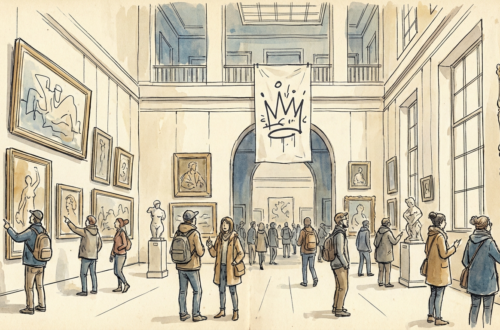
Venice 2026 and the Ongoing Revolution: How the ‘Stranieri Ovunque’ Legacy Is Permanently Changing the Biennale
The Moment That Changed Everything
There’s a particular kind of electricity that runs through the art world when something genuinely shifts beneath the surface. That’s what happened in 2024 when Adriano Pedrosa, the first Latin American curator to ever helm the Venice Biennale, titled his exhibition “Stranieri Ovunque” — Foreigners Everywhere. The title felt like a quiet provocation, an invitation to interrogate who gets to belong in the spaces that matter most. Now, as we move toward the 61st Venice Biennale opening in April 2026, that provocation hasn’t faded. It’s grown more urgent, more impossible to ignore.
What makes Pedrosa’s curatorial vision so significant isn’t just that he brought a different geographical perspective to the role. He fundamentally changed who the Biennale considers worthy of attention. The numbers alone tell a story: 331 artists exhibited in 2024, and here’s what should make you pause — 86% of them had never shown at the Biennale before. In an institution with 130 years of history, that’s the most expansive roster of debut artists the event has ever assembled. This wasn’t just a different curator making minor adjustments. This was a restructuring of whose voices get amplified when the world is watching.
What One Australian Artist Taught Us About Recognition
Remember the name Archie Moore. His work “kith and kin” won the Golden Lion for Best National Participation at the 2024 Biennale, and understanding why matters more than you might think. The piece involved 65,000 hand-chalked names meticulously tracing Aboriginal genealogy across 10,000 years. Imagine that for a moment: 65,000 individual names, each one representing a person, a family, a lineage, rendered in chalk across a massive surface. The work is fragile by nature. It asks viewers to consider what we erase, what we preserve, what gets deliberately forgotten.
When Moore’s work received the highest recognition, it signaled something profound about what the Biennale had become. This wasn’t an artwork that fit neatly into Western contemporary art conventions. It drew from Aboriginal knowledge systems and epistemologies that operate on entirely different timescales than the three-year cycles of biennales. Yet there it was, crowned as the year’s best national participation. That recognition rippled outward in ways that are still unfolding. Major institutions like the Guggenheim and Tate Modern both cited the 2024 Venice edition when making new acquisition decisions in 2025, and the numbers are telling: 18 new collection purchases specifically of artists from the Global South, directly influenced by what they saw in Venice.
The Uncomfortable Truth About Who Gets to Participate
Here’s where the conversation becomes less comfortable, and therefore more necessary. A 2025 report from the European Cultural Foundation revealed a stark reality that no amount of curatorial vision can completely overcome on its own. The funding disparities between national pavilions remain enormous. G7 nations average 2.1 million euros in pavilion budgets. Sub-Saharan African nations average 180,000 euros. That’s not a small gap. That’s a chasm that determines whose stories get told with which resources, whose artists can afford to make the journey, whose work gets printed in catalogs distributed globally.
This is why the “Stranieri Ovunque” legacy matters so much as we approach 2026. Pedrosa didn’t erase these inequalities — they’re built into the very structure of how the Biennale operates. But he made them visible. He created conditions where 86% debut artists could participate precisely because he actively worked to expand beyond the usual gatekeeping mechanisms. Artists with smaller budgets, with less institutional backing, with less access to international art world networks suddenly found room. At the same time, the conversation about whether that room was sufficient, whether it was truly equitable, whether it could last beyond one curator’s tenure, became impossible to avoid.
What 2026 Inherits From 2024
The Venice Biennale that opens in April 2026 will operate in the shadow of what Pedrosa accomplished and what he revealed. A new curator will bring their own vision, their own priorities, their own understanding of what art matters and who should speak for their nations. That’s natural. That’s how institutions change. But the precedent has been set. The La Biennale di Venezia Official Site will host an event that can never again pretend there’s only one way to select artists, only one geography of relevant contemporary practice, only one understanding of what constitutes a national voice.
This inheritance creates both opportunity and tension. Institutions hate to go backward publicly. But they also resist sustained structural change. Will 2026 maintain the commitment to including debut artists at similar levels? Will funding disparities finally be addressed, or will the numbers pull back toward something that feels more “balanced” to those accustomed to the old arrangement? These aren’t rhetorical questions. They’re the framework through which we should be watching the lead-up to the next edition. The decisions made in the coming months about curatorial approach, selection criteria, and which nations get supported will tell us whether 2024 was a genuine inflection point or a beautiful anomaly.
Your Invitation Into This Moment
What strikes me most about this entire situation is how it intersects with something deeply human: the hunger to see ourselves reflected in the places that matter. When Archie Moore’s 65,000 names won recognition, that wasn’t just about one artist. It was about validation for ways of knowing, ways of belonging, ways of making meaning that had been treated as peripheral for so long. When 331 artists — most experiencing the Biennale for the first time — filled the spaces of Venice in 2024, it meant something. It meant that for one moment, the world’s most prestigious contemporary art event decided that breadth of perspective mattered more than the appearance of curated exclusivity.
As we move toward 2026, I’d invite you to think about what you want the Venice Biennale to become and, by extension, what you want the entire global art world to be. These aren’t questions with simple answers. They require us to interrogate our own assumptions about excellence, about representation, about who deserves to have their work seen on the world’s stage. Watch the announcements. Read about the 2026 curatorial vision when it’s released. Think about whether it builds on the foundation Pedrosa established or pulls away from it. And stay curious about the artists whose names you’re learning for the first time — because they’re the ones reshaping what contemporary art actually means.


You May Also Like
What Retrospective and legacy writing Reveals About Film festivals and independent cinema in 2026
David Hockney’s iPad Paintings Are Forcing Us to Reckon with What Art Actually Is