When Colors Sing and Sounds Paint: The Hidden Conversations Between Music and Visual Art
The Rhythm of Brushstrokes: How Abstract Expressionism Found Its Beat
Picture Jackson Pollock in his studio, paint dripping from sticks and brushes in what appears to be chaotic abandon. Yet if you listen carefully to recordings of him working, you hear something remarkable: rhythm. The same syncopated patterns that defined bebop jazz were finding their way onto canvas through Pollock’s gestural movements. This wasn’t coincidence. Pollock and his contemporaries were regular fixtures at New York’s jazz clubs, absorbing the improvisational energy that Charlie Parker and Dizzy Gillespie were pioneering just blocks away from their studios.
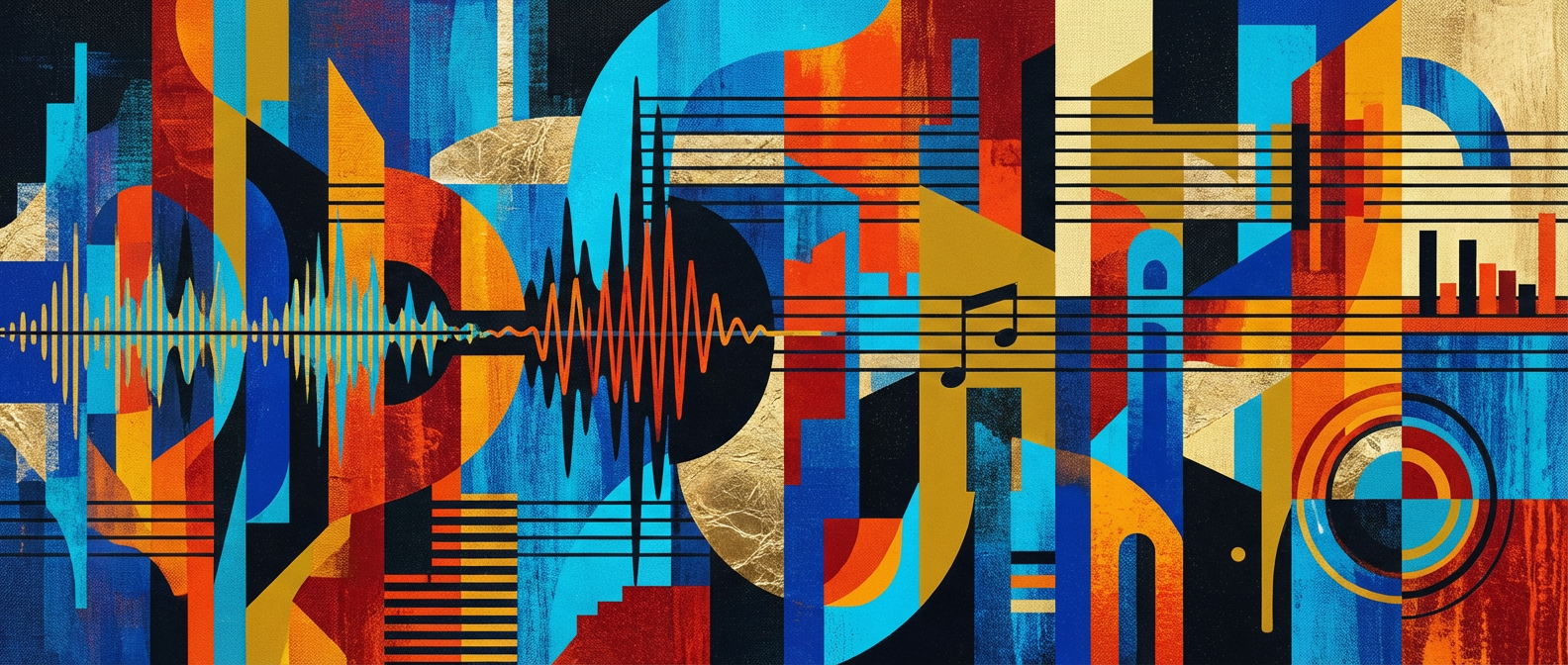
The connection runs deeper than shared cultural spaces. Both abstract expressionism and bebop came from the same philosophical rebellion against traditional structures. Where bebop musicians tossed out the predictable chord progressions of swing for complex harmonies and unexpected rhythmic shifts, painters like Willem de Kooning and Franz Kline ditched representational imagery for pure gesture and color. I’ve stood in front of de Kooning’s “Woman” series, and the brushwork mirrors the rapid-fire passages of a Parker saxophone solo. Each mark builds on the last in this complex improvisation.
Take Mark Rothko’s color field paintings and John Coltrane’s extended modal explorations. Both artists used repetition not as monotony but as meditation, letting subtle variations accumulate into something profound. Rothko’s “Red Studio” series and Coltrane’s “A Love Supreme” both pull you into sustained contemplation, where meaning comes through immersion rather than narrative. You have to stay with them.
Synesthesia in Stone and Sound: The Impressionist Revolution
Long before neuroscientists had a name for synesthesia, Claude Debussy and Claude Monet were exploring how one sense could trigger another. Debussy’s “Clair de Lune” doesn’t just evoke moonlight through its title. Its harmonic language mirrors the way Monet captured shifting light on his cathedral facades. Both artists understood that traditional techniques for representing reality couldn’t capture the fleeting, subjective experience of a moment.
The impressionist painters’ technique of broken color, where individual brushstrokes stay visible rather than blend smoothly, finds its musical equivalent in Debussy’s parallel harmonies and unresolved dissonances. Monet’s “Water Lilies” series requires your eye to blend colors from a distance. Debussy’s compositions ask you to experience harmony as atmosphere rather than structured progression. The effect in both cases is remarkably similar: a shimmering, ethereal quality that seems to exist just beyond our ability to grasp it fully.
This cross-pollination wasn’t theoretical; it was deeply practical. Debussy hung out at the same salons where impressionist painters gathered, and his notebooks reveal careful study of how painters achieved their effects. He wrote extensively about wanting to create “music without walls,” breaking down the barriers between inside and outside, just as Renoir’s outdoor paintings dissolved the distinction between subject and setting through their handling of natural light.
The Geometry of Rebellion: Cubism Meets Atonal Music
When Pablo Picasso shattered the Renaissance picture plane in “Les Demoiselles d’Avignon,” he was doing something remarkably parallel to what Arnold Schoenberg achieved when he ditched tonal harmony. Both artists questioned fundamental assumptions about how their mediums should organize reality. Picasso’s fragmentation of visual space into multiple perspectives mirrors Schoenberg’s twelve-tone technique, where no single note dominates the harmonic landscape.
The analytical phase of cubism, where Picasso and Georges Braque reduced forms to geometric essentials, shares DNA with the serial compositions of Anton Webern. Both approaches strip away emotional decoration to reveal underlying structural relationships. A Braque still life from 1910 and a Webern string quartet operate on similar principles. Maximum meaning through minimum means, where every element works double or triple duty.
But here’s what’s really interesting: both movements came from similar cultural anxieties about traditional authority structures. The fragmented perspectives in cubist paintings and the destabilized tonality of atonal music both reflect a world where single, unified viewpoints no longer seemed adequate. These weren’t just aesthetic choices; they were philosophical responses to a rapidly changing world.
Color Temperature and Emotional Frequency: The Fauve Connection
The Fauvists earned their name, “wild beasts,” for their aggressive use of color, but their wildness was precisely calibrated. Henri Matisse’s non-naturalistic palette operates on the same principles that guided Igor Stravinsky’s orchestration in “The Rite of Spring.” Both artists understood that emotional impact could be heightened by pushing familiar elements beyond their traditional boundaries while maintaining internal logic.
Matisse’s “Woman with a Hat” uses color the way Stravinsky uses rhythm in “The Rite”: as pure energy divorced from conventional expectations. Those shocking green shadows on the woman’s face work the same way as Stravinsky’s irregular accents. They force you into a more active, conscious relationship with the work. Neither artist was being arbitrary; they were applying new rules that put emotional truth over representational accuracy.
The influence flowed both ways. Stravinsky spent considerable time studying visual artists, and his ballet collaborations with painters like Picasso weren’t mere costume design partnerships. They were deep investigations into how different arts could amplify each other’s innovations. The famous riot at the 1913 premiere of “The Rite of Spring” wasn’t just about challenging musical conventions; it was about a total sensory experience that combined revolutionary music with equally radical visual design.
Contemporary Echoes: Digital Age Convergence
Today’s artists continue these conversations in new formats. Kerry James Marshall’s paintings pull visual references from hip-hop album covers while his composition techniques draw from jazz improvisation. The layered complexity of a Marshall canvas mirrors the sampling techniques that define hip-hop production. Both artists build meaning through strategic juxtaposition of found and created elements.
Electronic musicians like Aphex Twin and visual artists like Andreas Gursky work with similar approaches to density and detail. Both create works that reward distant contemplation and close examination, revealing different organizational principles at different scales of attention. Their work suggests that the old boundaries between high and popular culture, like the boundaries between different art forms, are becoming increasingly productive to cross.
These ongoing conversations remind us that the connections between music and visual art aren’t just academic curiosities. They’re active creative strategies that continue to generate new possibilities. The next time you find yourself in a gallery or concert hall, try letting your ears inform what your eyes see, or vice versa. You might discover that the Rothko across the room is humming a tune you recognize, or that the jazz quartet on stage is painting with sounds in colors you never knew existed.