
Kendrick Lamar’s Super Bowl LIX Halftime Show: The Art Statement the NFL Couldn’t Control
When 133 Million Viewers Witnessed a Deconstruction of American Mythology
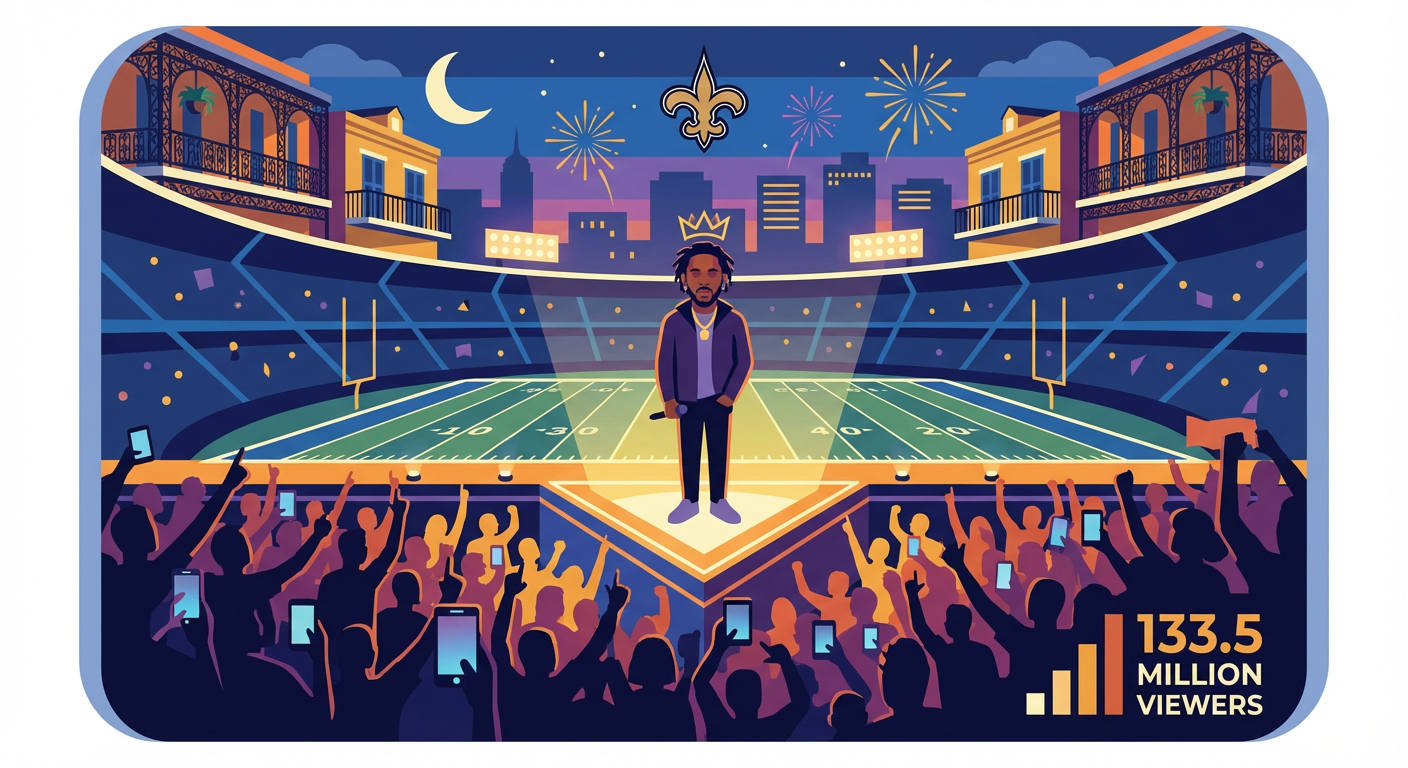
There’s a particular kind of artistic audacity that happens when a creator accepts an invitation into the machine and then uses that machine against itself. Kendrick Lamar’s halftime performance at Super Bowl LIX in New Orleans wasn’t just a concert sandwiched between commercials and network promos. It was a carefully orchestrated dismantling of the mythology that the NFL has spent decades constructing and protecting. With an estimated 133.5 million viewers tuned in, Lamar performed not just for the live stadium audience but for what might be the largest gallery opening in human history.

What makes this particularly fascinating is that the NFL, in its corporate caution, likely approved a setlist without fully grasping what it was endorsing. The league has a specific relationship with halftime shows: they’re meant to be spectacular, apolitical, and ultimately deferential to the institution itself. Lamar, however, arrived with something far more conceptually sophisticated than a typical celebrity performance. He arrived with an argument.
The Grammar of Visual Resistance: Black Flags and Afrofuturist Architecture
Walk through any contemporary art museum and you’ll notice how artists use specific visual languages to communicate ideas that words alone cannot quite capture. The Rothko chapel uses color fields to evoke spiritual presence. The best street murals use scale and positioning to reclaim neglected urban space. Kendrick brought this same visual literacy to the Super Bowl stage through his integration of Black American flag imagery and Afrofuturist design elements. These weren’t decorative choices. They were citations of a specific artistic and political tradition, deliberately invoking the work of artists like Hank Willis Thomas, whose installation “The Embrace” has become a touchstone for contemporary Black artistic expression in public space.
When you layer the performance’s visual language this way, you begin to see what Lamar was actually constructing: a counter-monument within the heart of American spectacle. The staging wasn’t aggressive in an obvious way. It didn’t announce itself. Instead, it operated through a kind of formal sophistication that makes you lean closer, that makes you want to understand the grammar being deployed. The Black American flags weren’t protest signs. They were more like a scholar’s footnotes, directing viewers toward an entire archive of artistic precedent and political meaning.
Samuel L. Jackson as the Living Text: Narrating the Collapse of American Mythology
One of the most intriguing elements of the performance was Samuel L. Jackson’s presence throughout the set as a narrator figure. Jackson isn’t just an actor. He’s a specific kind of American cultural text himself, someone whose career has spanned from blaxploitation cinema to blockbuster prestige. His very presence on that stage, inhabiting the role of narrator, functioned as what The Atlantic’s cultural analysis of the halftime show aptly described: a living embodiment of the American mythology that Lamar was systematically deconstructing.
Think about what that casting choice communicates when you slow down and really examine it. Jackson has spent decades navigating the entertainment industry as a Black man, often finding his agency within systems designed to constrain it. Having him guide viewers through Lamar’s artistic vision creates a kind of temporal layering, a suggestion that we’re watching multiple generations of Black artistic resistance operating simultaneously. The performance becomes not just Kendrick’s statement but something more dialogical, more conversational with the history of Black artists who came before and found ways to work within and against the systems that attempted to contain them.
When a Diss Track Becomes High Art: The Twice-Performed Provocation
Kendrick performed “Not Like Us” twice during the set. That song, the viral diss track that dominated cultural conversation for months, had just won the 2025 Grammy for Record of the Year, making it the first diss track to ever win in that category. Performing it twice, deliberately, during the Super Bowl LIX halftime show wasn’t a moment of spontaneous energy. It was a calculated choice to center confrontation within what is fundamentally a celebration of American corporate consensus.
By performing “Not Like Us” on that stage, before that audience, Kendrick was making an argument about artistic legitimacy and the legitimacy of dissent itself. Diss tracks occupy a complicated space in cultural hierarchies. They’re often dismissed as tabloid entertainment, cheap shots, personal feuds dressed up as performance. Yet here was one winning the highest honor the music industry offers, and then here was Kendrick doubling down on that assertion by making it central to his halftime statement. Nielsen streaming surge data post-Super Bowl showed that in the 48 hours following the performance, streaming of Lamar’s entire back catalog surged 1,400 percent. That’s not just commercial success. That’s proof that viewers moved beyond passive consumption into active engagement, seeking context and history and meaning.
The Quiet Brilliance of What the NFL Cannot Control
Here’s what the NFL presumably didn’t fully account for when they booked Kendrick Lamar: the difference between controlling a performance and controlling its interpretation. They can control the stage design, the technical setup, the timing between segments. What they cannot control is what an artist does with the most powerful platform in American entertainment. They cannot control the visual references, the conceptual density, the deliberate invocation of artistic and political traditions that viewers will then research and discuss and share.
What Lamar pulled off was a kind of artistic judo move. He didn’t refuse the NFL’s stage. He accepted it, but then he used the scale and reach of that stage to advance an argument that directly contradicted the mythology the league was trying to project. The performance was formally spectacular enough to satisfy the entertainment requirements of the moment. Commercially successful enough to justify the investment. And yet also conceptually sophisticated enough to function as serious artistic and political commentary for anyone willing to look closely, to see the citations, to understand the visual grammar being deployed.
The question that lingers is whether the broader audience that night understood what they were witnessing, or whether it simply washed over them as high-energy spectacle. Probably both things happened simultaneously. Some viewers connected with the intellectual architecture of what Lamar was building. Others simply enjoyed an excellent performance. That multiplicity, that ability to function on several registers at once, is exactly what distinguishes genuine artistic vision from mere entertainment. Kendrick brought the latter’s accessibility and scale but refused to surrender the former’s conceptual integrity. The NFL is still trying to understand what happened.